

A DIY vertical garden can be the perfect idea for a small space. Even a balcony, or a deck. And they come with the bonus of creating a privacy screen if that’s something you are needing as well! We used ours to screen our HVAC units that sit right off of our deck.
In this tutorial, we’ll show you how to build your own DIY vertical garden.

I’m no good at gardening. But I’m great at eating all the things that come out of a garden. So I have that going for me.
But regardless of my poor gardening skills, I’ve wanted to create my own vertical garden for a while now.
We have a “real” garden, but it’s a long way from our kitchen. I’m not complaining about having a big yard. It’s awesome for many reasons. But when I just want a pinch of dill, I always thought it would be great to just step outside my back door, and grab it from a little kitchen garden.
So I started pinning all kinds of vertical garden inspiration. I even wrote a post with over 50 amazing vertical garden ideas. But when it came time to build our own, we forged our own path.
We’ll show you how you can build your own, too.


Video Overview: How to Build a DIY Vertical Garden
We have a deck that we gave a pretty big (but cheap) makeover last summer. One of the areas we didn’t address though was this back corner.
As you can see, we have a lovely view out over the farmland. But then there’s this A/C unit sitting smack dab in the middle of my kumbaya lovely view.

That’s where we’re going to build our DIY vertical garden. It’s not going to totally obscure that unit, but it will provide something a little more zen-like to stare at over on this side of our outdoor space.
We’ll also be putting a lattice screen around that thing at some point…but not today…we’ve already got enough on our plate, right?
Actually, scratch that. There’s always room for a bit more cake on a plate, right? Yummmm.

Supplies Needed for Your Vertical Garden
- (2) 4x4x10 pressure treated posts
- (4) bags Quickcrete
- shovel and/or post hole digger
- line level
- 4′ level
- galvanized wire
- S hooks (outdoor rated)
- metal pails (we used these)…but I’d recommend galvanized pails or plastic
- drill
- turnbuckles
- cup hooks (use stainless steel or a type that will weather well)
- galvanized screws
- 1/2″ galvanized pipe
- (2) 3/4″ galvanized pipe stands
- lagbolts to bolt to deck
- scrap 2×4 or other lumber to brace posts
- quick clamps (AKA handiest tool ever)
How to build a DIY vertical garden
1. Make a plan.
Determine the width and height that you want your vertical garden to be.
Ours worked out to be about 7′ tall by 6′ wide. Clearly, this will be highly dependent upon the space you have to dedicate to this garden.

2. Dig 2 holes, at least 24″ deep and 12″ round for your 4×4 posts.
To dig the holes use a shovel and or a post-hole digger…this is the suckiest portion of the project, in our opinion.
If you have a teenager at home, you’re in luck. Tell em it’s payback for eating you out of house and home (I can’t seem to stop talking about eating).

3. Place posts in holes, brace and plumb.
You’ll now want to stand your posts in the holes and brace them with your scrap lumber so that they can stand upright (plumb) while your concrete is setting.
Below you can see how we used a scrap 1×4 to brace our post in an upright position, and used the level to make sure the post remained in a perfectly vertical position.
Make sure that you brace your post in TWO directions…you need to make sure your post is plumb from both side-to-side and front-to-back (you can see the second piece of scrap used in the photo below).

4. Set concrete in post holes.
It’s now time to set the posts, using your concrete. We used Quikrete.
Follow the instructions on whatever brand you go with as far as determining how much you’ll need, and getting the concrete to set appropriately.

5. Wait for the concrete to completely set before continuing.
Gardening, NOR patience are my strong suits. But you’ll have to wait as long as is required per your concrete instructions to allow your posts to completely set, and the concrete to cure.
We’ll be putting some stress and tension on these posts as we rig up our wire system, so you don’t want to move forward before the concrete can hold up to the task.

6. Install lag bolts.
Maybe you’ll be doing this step, maybe not. Since we placed this DIY vertical garden next to our deck, we used two lag bolts on each post to help anchor the posts to the deck.

We hoped this would help in keeping the posts from bending inward once we attached the wires.

7. Install cross brace.
Full disclosure here…we installed the wires first, but it actually bent the posts in too far and we could not get the wires tight…so we installed this 1/2″ galvanized pipe at the top to keep the posts separated.
We did not realize how much force those wires put on the posts!

Use 3/4″ pipe stands installed on either post and then cut the 1/2″ pipe to length and install between the pipe stands.
We used 3/4″ pipe stands so that the 1/2″ pipe would slide into the pipe stands…if you used 1/2″ pipe stands the 1/2″ pipe would need to be screwed into the pipe stand and that would much more of a challenge.
8. Determine desired height for rows of wire, then mark post.
Take a look at the size of your planting buckets (hint: make sure your pots are going to hold up to the weather…we learned this the $$ way), then at the overall size of your frame. How many planters will you be hanging?
Use these details to plan out where to anchor your wires to the frame.

We decided to install four rows of wire. Each wire would hang four planter buckets.

We started simply by eyeballing where we wanted the top row to hang. Then did some handy math to make sure the four wires would be evenly spaced along the height of our posts.
We penciled in the location for the anchors along one of the posts.

9. Pre-drill holes for hooks and screw them into one post.

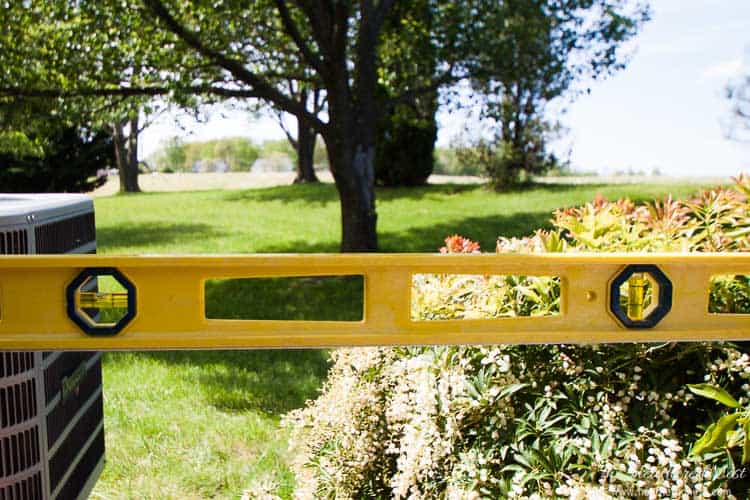
10. Measure locations for corresponding hooks on the opposite post. Use a line level to ensure locations are correct.
Tie a string around the hook you just installed and pull it over to the other post. Use a line level to get the string nice and straight and then mark where the hook should go.

If you don’t have a line level, a standard level can be used instead, it’s just a little harder for this particular job.
11. Screw hooks into the second post.
Once you know where the first hook goes on that second post, simply measure up the same distance and install the four hooks on this post.
12. Using a cable clamp, make a loop on one side of the wire. Secure the loop on your hook.

Another view of the loop…

13. Make another loop on the other end of the wire. Use turnbuckle to tighten the wire.
Open the turnbuckle about 90% and attach it to the hook. Then loop the wire around the turnbuckle hook and pull it as tight as you can. Secure it with the wire clamp. Now close the turnbuckle until the wire is taut.

14. Repeat the process to attach additional wire(s) to your vertical frame.
15. Plant some stuff!
I am NOT going to give advice in this realm. I have no idea what I’m doing. We put some rocks in the bottom of our pails, threw in some dirt, then stuffed in our herbs.

They looked good (for a while). Then slowly and painfully, I began killing them off, one by one. Sad story, but true.
And remember the cautionary tale I’ve discussed a bit already: the buckets we chose did NOT last longer than a season. They TOTALLY rusted.
This year, I’m going to buy either galvanized pails or some type of durable plastic. Just an FYI. Don’t make the same mistake!

And soon, it will be time to enjoy all the fruits, vegetables, and herbs of your labor.

Happy (vertical) gardening, friends!

Looking for more outdoor DIY, or spring and summer home improvement and home decorating ideas? Be sure to check these articles out, too!
Pin this DIY vertical garden tutorial for later! And if you make one, leave a comment (or better yet, a photo) on the pin! That helps others know whether they want to try this project, too!

Pssst…before you go, I sure would love to hang out with you again really soon! Sign up now and get a no-cost copy of “Builder-Grade To Beautiful: 10 Totally Transformative Home Decorating Solutions, All Under $100!” Click here to enter your email or on the image below. Your copy will be emailed right away!



Nan says
Looking at your pictures, it looks like the only things you planted in your vertical garden were herbs. Is this true? I really like the idea but we’re not into herbs. Most of the things we plant need lots of root room. I’m not sure this would work for us. We have had quite a bit of success with using the teepee method with our squash and cucumbers though. It gets the vines up off the ground so they are easier to pick and we lose less to rot from being wet on the ground.
Heather says
Hi Nan, yes…only herbs! I don’t grow anything other than herbs…and weeds! ?? I’ve always wanted to try the teepee method for the cucumbers, too! It looks like it would be helpful for keeping them off the ground and rotting early if the ground is too wet. Maybe one year we’ll give it a go!