


A $1000 DIY kitchen remodel reveal…
A $1000 DIY kitchen remodel reveal… Okay, let’s be honest about the numbers up front. We spent $1,935 on this DIY kitchen remodel on a budget and sold $900 worth of our old furniture to offset it, which brought our net cost to $1,035. This is the story of how far that money stretched. Every kitchen is different, and so is every homeowner’s comfort level with DIY, so take what works for you and leave the rest.
But one thing that remains the same? Kitchen renovations are the mother of all homeowner expenses. In 2026, a typical kitchen remodel averages around $24,000 according to Home Depot’s cost guide, and even a minor cosmetic update can run $10,000 or more with a contractor. And when you don’t have a mother of all budgets to work with, like us, you may have to take baby steps, doing what you can with the budget available. Even when what’s available is $1000.
Our Dated Oak Kitchen Before the Budget Remodel
This was how our kitchen looked when we moved in. Huge? Yes. Dated? Definitely. Oak and cherry as far as the eye could see, and the darker finishes left the whole place looking kind of cave-chic. Even on a sunny day, it felt like the light had to make an appointment to get in.
Here’s the layout: the kitchen, a little kitchenette, deck doors, a powder room, and a playroom that somehow became the center of everything. Take a look at the before pictures below, then come back for the after.

Before I dive into this reveal, if you’re looking for the painted floor tutorial, here it is: How to Paint Hardwood Floors (Step-by-Step). Come back and finish reading when you’re done. I’ll be here.
While you can certainly sit back and save, patiently awaiting the day you have the budget for the kitchen renovation of your dreams, sometimes doing something feels better than doing nothing. After 5 years of patiently waiting for our bigger budget to arrive, I decided I had waited long enough.
I’m sharing this budget kitchen makeover because I hope it’s inspiring to see how far money can be stretched with a willingness to DIY and the drive to change your space. Just keep in mind that this project was done in 2019. Prices, materials, and building rules have changed since then, so I’ve added 2026 price notes throughout this post.

You’ll see exactly how far our DIY kitchen remodel story got on a budget of $1000. And here is where the story begins. Cue the BEFORE pictures!
This was how our kitchen looked when we moved into our home. Huge? Yes. Dated? Definitely. Nothing but oak and cherry as far as the eye could see.

Was it horrible? No. It just wasn’t us. And despite the small window over the kitchen sink, and the french doors in the eat-in-kitchen area, the darker finishes left it looking dark and kind of cave-chic. Even in the middle of the day.
Above is the view from the kitchen into the kitchenette area. The french doors you see toward the left lead to our deck. The doorway directly behind the table goes into our powder room and laundry room area.
The open doorway toward the right side of the picture above leads to our formal living room, or what we use as the playroom. AKA the hottest mess in the house at any given time.
Now let’s get down to the nitty-gritty numbers. Here are the expenses we incurred, and items used to offset costs for this DIY kitchen remodel:
Safety disclaimer
A quick but important note before you grab a sledgehammer: This project happened in 2019. Building codes, permit rules, and electrical standards change over time and vary by city, province, and state. If you’re thinking about removing a wall, cutting into drywall, or touching any wiring, please hire a licensed structural engineer, building contractor, or electrician where required, and check your local rules first. Walls can hide wiring, plumbing, gas lines, and even surprises like termite damage (spoiler: we found some). What worked for us may not be right for your home. This post is shared for inspiration and general information, not as professional advice.

DIY Kitchen Remodel Sources:
- Primer – $131
- Porch & Patio Paint $40
- Cabinet and Baseboard Paint (Semi-Gloss) $40 (Behr, plain white straight outta the can)
- Wall Paint $40 (Ben Moore “Pale Smoke”)
- Spray Paint (counter stools, island lights, kitchenette chairs) $120
- Kitchenette Chairs (via Craigslist) $75
- Kitchen Table $625 upwards
- Kitchenette Rug $220
- Striped Rug in Kitchen $172-300
- Molding for Kids Art Display $100
- Fabric for Kids Art Display $21
- Accordion Arms for Sconces $20
- Utility lights for Sconces $75
- Lumber/Drywall/Supplies for new wall cutout $300
- Blade to cut granite $30
- (2) new counter stools $55
- Plexiglass + Hooks for Art Display $145
- Electrical Supplies $35
TOTAL: $1935
Old Kitchen/Dining furniture sold to offset project costs: $900 (old kitchen table, chairs, (2) rugs, upholstered bench, foyer settee) Note: selling items before a remodel is a great way to offset purchases! If you know you won’t be needing or using items in your renovated space, then sell them! We wrote a post all about how we do that if you want to check it out!
NET COST: $1035
2026 Cost Breakdown (Updated Prices)
Here’s what the same materials would cost in 2026, based on current retail prices and estimates. The 2019 list above shows what we actually spent. This breakdown helps you see how inflation has shifted the budget, and it gives you a realistic starting point for your own project.
| Item | 2019 (US$) | 2026 US$ |
|---|---|---|
| Paint and primer | ||
| Primer | $70 | $50–$70 |
| Porch and patio paint (floors) | $62 | $60–$75 |
| Cabinet and trim enamel (Behr) | $62 | $55–$75 |
| Wall paint (Pale Smoke) | $31 | $45–$75 |
| Spray paint (stools, chandeliers, chairs) | $120 | $120–$160 |
| Furniture and seating | ||
| Kitchenette chairs (used) | $75 | $75–$150 |
| Kitchen table (used) | $625 | $400–$700 |
| Kitchenette rug | $220 | $150–$300 |
| Striped kitchen rug | $172 | $120–$200 |
| Two counter stools | $55 | $60–$150 |
| Wall removal | ||
| Lumber, drywall, supplies | $100 | $140–$200 |
| Granite-cutting blade | $15 | $20–$40 |
| Lighting and electrical | ||
| Sconce arms | $20 | $20–$40 |
| Utility lights for sconces | $20 | $20–$40 |
| Electrical supplies | $35 | $40–$80 |
| Art display | ||
| Molding | $100 | $100–$150 |
| Fabric | $8 | $8–$15 |
| Plexiglass and hooks | $145 | $120–$180 |
| Total | $1,935 | about $1,600–$2,700 |
| Sold old furniture | –$900 | -$900 |
| Net | $1,035 | $700–$1,800 |
Currency note for Canadian readers: These 2026 US prices are in US dollars. As of October 2026, the USD to CAD exchange rate is approximately 1.38. Multiply the US$ figures by 1.38 to get a ballpark Canadian estimate. For example, the US total of $1,600–$2,700 would be roughly $2,200–$3,700 CAD. Check current exchange rates and verify Canadian retail prices on Home Depot Canada, Kijiji, or local suppliers for the most accurate budget.
How the 2026 Figures Were Built
Lumber and drywall are the easiest to price. A 2×4 stud costs about $3.60 to $5.60 at a lumber yard in 2026, so 10 studs come to $36 to $56. A 1/2-inch 4×8 drywall sheet is listed at $13.48 on Home Depot’s calculator, so 4 sheets come to about $54 to $62. Add roughly $50 to $80 for joint compound, tape, screws, and patching supplies, and the total comes to $140 to $200.
For paint and furniture, check current listings on Kijiji, Marketplace, or Craigslist, and use the middle of the price range you see. Enter the amount you actually received when you sold your old furniture to calculate your real net cost.
DIY Refresh vs. Professional Remodel: Why Our Number Looks So Small
If you’ve spent any time Googling kitchen remodel costs for 2026, you’ve probably had to sit down. Angi’s homeowner survey puts the national average at around $26,941, and a midrange minor remodel comes in around $28,458 in the 2025 Cost vs. Value Report. Even Home Depot’s cost guide lands near $24,000.
So how on earth did we do ours for $1,035?
Simple. We didn’t hire a professional minor remodel. We did what I’m calling a Surface-Level Cosmetic DIY: paint, lighting, furniture, and one very dramatic wall. No new cabinets, no new counters, and no contractor crew, just us, a lot of tape, and more coffee than I’d like to admit.
Where the Money Goes (and Where We Saved)
The biggest chunk of any renovation bill is labor. When you hire a pro, you’re paying for materials, but also for project management, skilled hands, and overhead. That’s fair, and it’s also why the quotes get scary fast.
We split the work two ways:
- The “Pro” side (structural and safety): We didn’t gamble with the house. Before we touched the wall, a structural engineer checked that it wasn’t load-bearing. We got that check as a favor, but most people will pay for it, so budget for it. We count it as a safety step, not part of our cosmetic budget.
- The “DIY” side (everything else): Painting, cleaning, drywall patching, sanding, furniture assembly, and the wall demo itself. Doing the labor ourselves is how we skipped the line item that makes professional quotes so large.
Want a real quote for your own kitchen? Get two or three local contractor estimates before you decide. Pricing varies a lot by city and province, and smaller local crews can sometimes come in below the national averages above. Compare the scope line by line, not just the bottom number.
Which Path Is Right for You?
f you have $20,000 or more and want a polished, turnkey result, a professional remodel is a perfectly good call. But if you have more time than money (hello, us), a Surface-Level Cosmetic DIY can change a room dramatically for a fraction of the cost.
Stick to the high-impact stuff: paint, lighting, and layout. Do the grunt work yourself, and have fun with it. Anything structural should go to a licensed engineer and contractor. For electrical work, check your local rules before you start, because what a homeowner can legally do varies by location, and some jobs require a licensed electrician.
Safety snippet
Before you swing a hammer: Check whether a wall is load-bearing, and check your local rules before you cut or remove anything. If you find wiring, plumbing, gas lines, or rot behind the drywall, stop and call a licensed professional. Our project is for inspiration, not a blueprint.
Heads up: If your wall is load-bearing, don’t DIY the removal. Hire a licensed structural engineer and a licensed contractor, and check your local building department for the rules where you live. Our project is for inspiration, not a blueprint.
Let’s get working – Opening a Wall and Painting Everything in Sight
This project boiled down to two main tasks: opening a wall and lots of painting. Here’s how things turned out…

Opening the Wall Between the Kitchen and Family Room
If you look at the before pictures, you’ll see that originally, the refrigerator stood against a wall that separated our family room from the kitchen. We decided to remove that wall.

Above is a shot before the wall removal was complete. It was a bit of a challenge for two reasons. First, we found termite damage.

Trust me when I say that seeing something like that behind your drywall is enough to send you running for a bag in which to vomit.
Thankfully, after more exploratory surgery, we were able to determine that the damage hadn’t affected the structural integrity of the house, but we still took the time (and money) to shore up the framing between the two spaces.

In the shot above, you can see that the original doorway and header between the two rooms is still intact.
We needed to check with a structural engineer to make sure that this wasn’t load-bearing before plowing ahead and removing it.

Luckily, it was ok to remove which really opened things up. We salvaged an upper cabinet that we had removed, on the wall where the refrigerator originally sat, as seen below.

And created another base cabinet from it. You can see below how Tib added wood in the rear and base of the upper cabinet so the size matched the other base cabinets. This preserved some storage space, and added counter space back to the kitchen.

Being able to get rid of the whole wall separating the kitchen and family room made a WORLD of difference.

Plus, it wasn’t an expensive change to make. Labor-intensive? Definitely. But since this is a DIY kitchen remodel, we just chipped away at that part of the project at our own pace, and only had to pay for the lumber and drywall we needed to finish off the opening.

Before you open any wall: Check whether it’s load-bearing, and check your local rules before you cut or remove anything. Walls can hide termites, wiring, plumbing, and gas lines. If you find any of those, stop and call a licensed professional. Our project is for inspiration, not a blueprint.
2026 note for readers: Material costs for this kind of framing and drywall work are in the 2026 table above. Your costs will depend on what’s inside your wall and how much of the work you handle yourself.
Paint Did the Heavy Lifting
As far as bang for the buck goes, beyond opening that wall, PAINT was really what transformed this space.
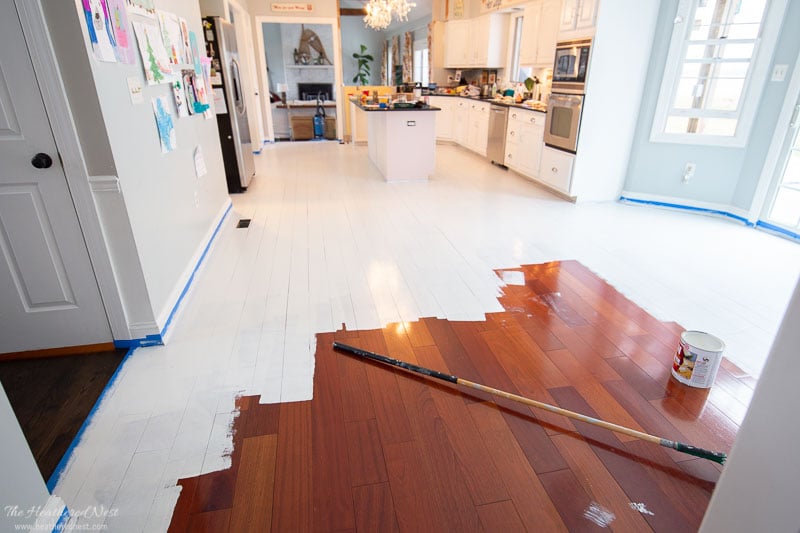
Specifically, painting the cabinets and the floors.
The cabinets:I had painted the cabinets white the first year we moved in. I just couldn’t take the oak anymore. One Saturday morning, while Tib was making pancakes for the kids, I whipped out the chalk paint and just started slapping it on the cabinets. No prep, nothing. Just slapped it on. And that lasted until I repainted them during this project.
Below, you can see how the cabinets looked with the chalk paint and new hardware I put on a couple of years back. It was a big improvement at that point in my eyes!

This time around, instead of chalk paint, I used semi-gloss latex paint in the brightest white I could buy (which is just straight outta the can…no mixing, nothing).
See that command center/deck area above? We removed the countertop and repurposed it over on the other side of the kitchen. The refrigerator now sits where the chair is above.

The Floors – The floors? Here’s a link to the painted hardwood floors tutorial.
The floors are where we broke the rules. The story on those is that I painted them without sanding. That’s a no-no. But these cherry floors were factory-finished rather than sand and stain in place. And that means that the factory coating is almost IMPOSSIBLE to remove, no matter what type of sanding tool or grit of sandpaper you throw at it.

So I came up with my own floor painting technique. I figured my floors could be the guinea pig. If this method worked, perhaps it would help some of you!
And I’m happy to report that as of the latest update to this post in 2023, the floor held up great for over FOUR years while this space awaited the FULL renovation that we dreamed about since we first moved into this house.
Most people were SURE it would scratch, peel, and look generally terrible after a couple of weeks…months at best. But it didn’t! No peeling, or scratching at all. It DID get some scuffs from time to time, but that happens to all floors, and we were easily able to remove those without damaging the paint.
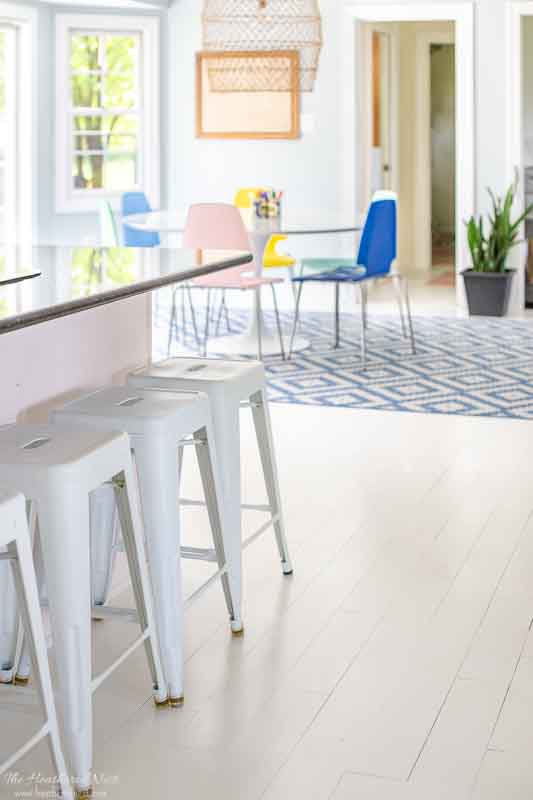
The chairs and stools: I found six kitchenette chairs on Craigslist for $75 and spray-painted each one a different color, inspired by the striped rugs in our home. The counter stools got the same treatment.

That’s the ad above ☝️. I got 6 chairs for $75, and spray painted them each a different color

using the colors in our new striped rugs (seen in the laundry room, hallway and by the kitchen sink) from Annie Selke as the inspiration.

Above is the view from the laundry room, into the hallway where our powder room is, and into the kitchen.
See the floors in here? That’s the plywood subfloor that I painted! We peeled up the old linoleum and slapped on some paint!

Before, we had so many types of flooring in a really small area. There were 4 different kinds on the lower level of the house.
Removing the linoleum, and painting the laundry/mudroom and kitchen floors to all match brought some more consistency into the house.

Plus, it really lightened up these dark areas that don’t get a ton of natural light during the day.
The chandeliers:I also spray-painted the two chandeliers above our kitchen island. I’m still not sure I’m a superfan of how that turned out, but I’m going to live with them for a while longer and see how I feel as time goes by.
See them? The bright yellow? I know…hard to miss 😉
Painting safety: Spray paint and paint fumes need good ventilation. Open windows, wear a mask rated for the product, and follow the can’s directions for drying time and safe use. Keep kids and pets out of the room until the paint has fully cured.

UPDATE! It took about a year, but I decided to switch out those yellow chandeliers. Here’s a picture (and a kitchen lighting update post) with the new pendant lighting. What do you think?

I like how the new pendant lights allow your eye to flow through the kitchen and into the family room more easily. And they were less than $100 each, which I was happy about!
The last project I’ll mention in this DIY kitchen remodel is the kids’ art gallery wall.

Don’t mind Cedric Piggory (our hairless guinea pig) there on the table. He hangs around the kitchen looking for snacks.

In the pic above, he’s still sitting on the table while I’m holding Humphrey Bogart, who is snacking on some organic romaine lettuce. We have very fancy guinea pigs here.

Here’s a tutorial for the kids’ art gallery wall. It’s basically a framed-out area of the wall, done with molding. The back of the wall is an inexpensive fabric that I hung using starch.

And the artwork is covered by two large pieces of plexiglass (seen above) that we can easily remove from the hooks we installed when the kids want to change out their artwork.

The kids love seeing their artwork hung in such a prominent place in the house. And we do, too!

After all, the kitchen is the heart of the home, right? So it is the perfect spot to display those things that are closest to our hearts.
And that about wraps it up! There are so many little details of this space and tutorials for little projects that we tackled in here that I can’t wait to share with you.
I hope that you like how the space transformed. There are changes in here that are not right for a lot of people.

That said, this DIY kitchen remodel can be a great reminder that your home is YOUR home. If you own it and you want to make a change, then DO IT!
Don’t skip it because it’s not something for the masses. It only has to be right for you and your family. Forget everyone else. Love where you live. Even if you only have a small budget to see your visions come to life.
FAQ
Back in 2019, a reader named Amy asked what the engineer check cost, since it wasn’t in our budget. Fair question. Here’s the honest answer: we got lucky. Dave, a mechanical engineer, works with some structural engineers who were willing to take a look. That was a favor, not a price list, so please don’t budget for free.
So what should you expect in 2026? In the US, structural engineers typically charge $100 to $250 an hour, and a simple inspection runs about $350 to $900. If your wall is load-bearing, you’ll likely need stamped drawings, which can run roughly $1,000 to $3,000 in the US. In Toronto, one local contractor lists $1,500 to $3,500 CAD for stamped drawings and site visits. Rates vary by city and province, so call two or three local engineers for a quote before you commit.
Heather’s 2019 guess of $150 an hour still falls inside today’s US range.
I have seen a few models of trending styles – Warm wood islands are a leading look. Oak, walnut, and mixed-species wood bring natural character and soften the room. Islands are also getting bigger: about half of renovated islands are longer than seven feet, often rectangular.
Keep in mind that if you have to move appliances, there is enough space to push them to place and turn around. Plan for clearance on both sides of the island. Allow about 36 inches for a general walkway, and about 42 inches if one person cooks there regularly. Add your island width to clearance on both sides to find the minimum room width. For example, a 12-foot (144-inch) wall with 42 inches on each side leaves about 60 inches for the island.
It depends on the counter height. Designers suggest about 15 inches of overhang at a standard 36-inch counter, and about 12 inches at a 42-inch bar height.
Often yes, but only a small one. In a 12-foot room with 36 to 42 inches of clearance on each side, the island can be about 5 feet wide at most. Check your own layout before you buy or build anything. Most important, see if you have enough clearance to move in/out appliances.
Start with the changes that have the most visual impact for the least money: paint the cabinets and walls, update the lighting, and swap the hardware. In our kitchen, paint and lighting did most of the transforming. The new pendant lights were under $100 each.
The 2025 Cost vs. Value Report lists a midrange minor kitchen remodel at about $28,458 in job cost, with an estimated resale value of about $32,141. Resale value is a estimate, not a guarantee.
Want more budget-friendly home decorating and DIY project ideas? Be sure to check these out, too:
Pin this post for later!

Pssst…before you go, I sure would love to hang out with you again really soon! Sign up now and get a no-cost copy of “Builder-Grade To Beautiful: 10 Totally Transformative Home Decorating Solutions, All Under $100!” Click here to enter your email or on the image below. Your copy will be emailed right away!




Jen says
Wowwwyyyy…I’m so impressed! I love that you added arches to the opening into the family room!
Jonathan says
Did you redo the countertops as well? Did you put new ones in or repaint them? If so, how did you do it? Thanks.
Heather says
Hi Jonathan, no…we didn’t do anything to the counters for this makeover.
Susy Shaw says
Hi Heather!! I love your blog! I am about to DIY or pay for my cabinets to be painted..I also love your DIY outside movie theater… will be doing that too!
Two questions; are all the really bright rugs from this store? https://annieselke.com
And where did you get your long bench? I love the bright colors… totally my style and everyone is doing just all white everything…. boring…! 🙂
Delta Love 🙂
Susy (Jordan)
Heather says
Hi Susy!!!YES. Annie Selke for the (striped) rugs…here’s the link (it’s for a random size, but you’ll see the options: http://bit.ly/31gHLLj The long bench is from Crate & Barrel…here’s a link for it: http://bit.ly/2NbZT5q And YES…couldn’t agree with you more. The all white look feels sanitorium-chic to me. And I don’t need anything else to make me feel crazier than I already do 😂. Miss you!!! Smooches 😘, H
Linda says
Do you mind sharing info about
The art that is hanging in the hall by the powder room? Love it
Heather says
Hi Linda, that art…if you’re talking about the piece with the teal mat, is an original of a street in my college town, Blacksburg, VA. I love it as well and need to look up the artist to see if he is still selling pieces. I bought it over 20 years ago at this point. But his name is Barnaby Jackson. If I find any more of his work, I’ll let you know! And if that’s not the piece you’re referring to, shoot me another message.
Toni | Girl, Just DIY! says
Oh my gosh the transformation is amazing! Great job so many little details that add up to a beautiful and cost-effective remodel.
Heather says
THANK YOU so much, Toni! That is so appreciated 🙂 So glad that you like it!!!
Sandi Magle says
Golly, we lived with dark walnut stained cabinets for 32 years and finally redid the kitchen in all white cabinetry…and I love it! This is quite the transformation, and super for a busy family. Lucky you, to have great cabinets and countertops for your transformation. PS—who doesn’t need a chandelier somewhere and yellow makes it so fun!
Heather says
Well, our cabinets are definitely not great…they aren’t in the best shape, but they will do for a few more years. If was certainly worth the cost of a gallon of paint to extend the life a wee bit longer. Thanks so much for taking the time to comment, Sandi 🙂 🙂
Amy Oldham says
Hi Heather! I have a question about the wall opening. I didn’t see it in your budget, but you mentioned that you had an engineer come to check if the wall was load bearing. We need to do the same thing, but I have no idea what that will cost. Do you mind sharing?
Thanks! Love the kitchen!
Amy
Heather says
Hi Amy, yes we lucked out on that front since Dave is a mechanical engineer and works with some structural guys who were able to take a look. It’s tough to say how much it would be for you since I don’t know anything about your specific situation, but I’d estimate about $150/hour for an engineer to take a look at your project. Not sure that’s accurate, but that’s Dave’s guess.
Novene Barbieri says
Love it!!! Where did you get the rug??
Heather says
Hey Novene! Thank you! All the sources are linked in the source list/budget in the post 🙂
Sue says
Absolutely stunning. I love everything you do to your home. This kitchen is a keeper.
Heather says
Thanks so much Sue!!
COLLIER A. says
Beautiful job! You’ve inspired me to finally tackle my outdated kitchen! So many good ideas. I adore the space for the kids artwork.
Heather says
Yeah!!! So glad!! I hope you decide to take on the kitchen, and if you do, let me know how it turns out for you!!
Kim says
Obsessed!!! Great job Heather and Tib.
Heather says
You like it?! Yeah!!! So glad 🙂 That’s high praise 😘
Mary says
It looks like a different kitchen…and all fit around $1000! The power of paint is amazing! I love how the floors turned out!
Heather says
Exactly. Paint is such a powerful thing. Completely underappreciated, I think! Thanks for your comment, Mary! So glad to hear you like the “after”!!